
Sugar on antibiotics, a valve that grows, and the age of your voice
This week's stories run from hospital meal trays to a heart valve built for growing children. Several of them turn on the same gap: the distance between what a study found and what it was able to prove.

- Observational study
- 173 transplant patients
Antibiotics don't only hit the bacteria making you sick. They also thin out the crowded community living in your gut. A new paper in Nature asks whether what you eat while that's happening changes how hard the hit lands.
Researchers tracked 9,419 meals eaten by 173 people in hospital for a stem cell transplant, a treatment usually given for blood cancers. They matched those meals to microbiome samples from 158 of the patients. People who ate more sweets and sugars while on antibiotics showed greater disruption. Their gut communities had fewer kinds of bacteria, and Enterococcus, a bacterium that can cause disease, expanded further.
Meal records can't separate sugar from everything else happening to a very sick person, so the team turned to mice. Adding sucrose, ordinary table sugar, made antibiotic-driven Enterococcus blooms bigger and longer-lasting. According to the press release, each 100 grams of sugar eaten in the 48 hours before antibiotics was linked to an additional 21% drop in bacterial diversity.
That is where the evidence stops. Transplant patients go through intensive treatment and are very different from a healthy adult taking a short course of antibiotics. The human data show an association, and the cause-and-effect evidence comes from mice. The authors say the finding needs checking in independent groups of patients and in studies that actually change what people eat.
Published October 4, 2026
- Multiple studies
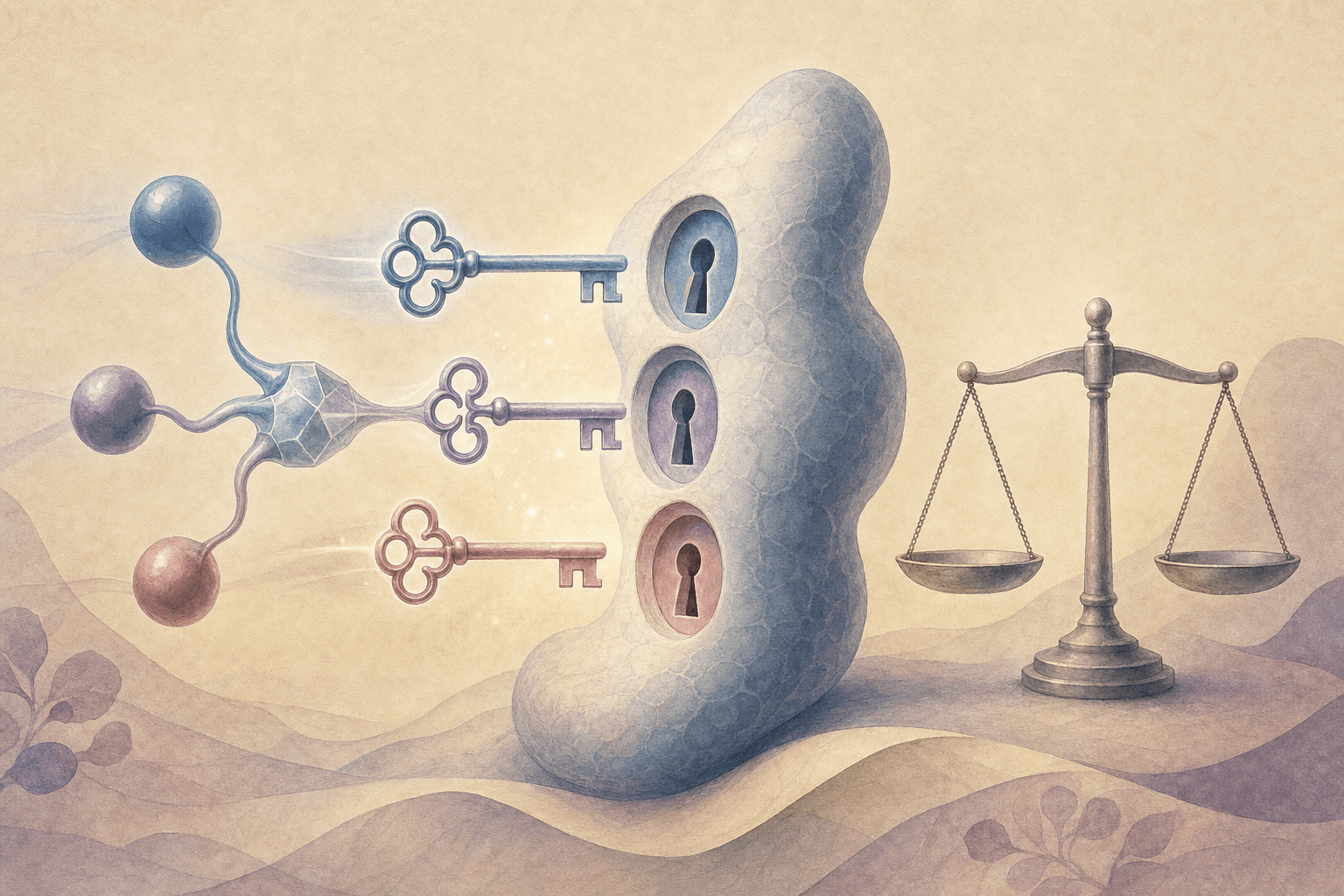
Retatrutide, from Eli Lilly, acts on three hormone receptors: GLP-1, GIP, and glucagon. On September 29, The Lancet and the New England Journal of Medicine published its first big late-stage trial results, and they include a split worth noticing.
In the NEJM trial, 2,339 adults with obesity were randomly assigned to one of three doses or a placebo. Average weight change ranged from -17.6% on the lowest dose to -23.7% and -25.0% on the higher ones, compared with -3.9% on placebo.
People who also had type 2 diabetes lost less. In the Lancet's TRIUMPH-2 trial, 1,152 adults with obesity and type 2 diabetes received 4, 9, or 12 mg of retatrutide or a placebo. After 80 weeks, average weight changes were -11.9%, -16.8%, and -18.8%, against -5.1% on placebo. Diarrhea affected 27% to 34% of people taking the drug, versus 13% on placebo.
Two questions remain open. Lilly funded both trials, and both compared retatrutide only with a placebo, so nobody yet knows whether it does better than the drugs people can already get. Retatrutide is also not approved.

- Randomized trial
- 703 older adults
- 2 years
Hearing loss has been linked to dementia, which raises an obvious question: if you treat the hearing, does the mind follow? The CHOICE trial, published September 28 in JAMA Neurology, put that to a test in China.
It enrolled 703 older adults, average age about 74.5, who had moderate-to-severe hearing loss and mild cognitive impairment, a stage of memory and thinking problems that falls short of dementia. Participants were randomly assigned either hearing aids or education about hearing health, then followed for two years.
Thinking scores improved in 15.34% of the hearing-aid group, compared with 2.36% of the education group.
The dementia question got a murkier answer. Over the two years, 3.09% of people with hearing aids progressed to dementia-level impairment, versus 4.74% in the education group. That gap was not statistically significant, so it could be chance. Better test scores and preventing dementia are different outcomes, and this trial showed only the first. No study-related adverse events were reported. Because the comparison group received education rather than nothing, the trial measured hearing aids against an active alternative, not against doing nothing at all.

- Regulatory approval
- 62 children
- 6 months
An implanted heart valve stays the same size while the child it was implanted in keeps growing. For children born with pulmonary valve disease, outgrowing a valve often means repeat open-heart surgery.
On October 1, the FDA approved the Autus Size-Adjustable Valve, which is designed to grow with the child. It starts at about 13 millimeters across and can be widened to 22 millimeters with a balloon catheter, a thin tube with an inflatable tip. That expansion takes the place of a replacement in open surgery. Its flaps, called leaflets, are made of a synthetic polymer.
The approval rests on a trial of 62 children at 12 sites. At six months, the first 60 had acceptable blood flow with no more than mild leakage, and there were no deaths, strokes, or clot complications. Three valves had fractures in their frames, and two had leaflets that moved less than they should. None of those children had symptoms.
Six months is a short window for a device meant to last through childhood, and doctors have limited experience so far with actually widening the valve. Studies of how well it holds up over the longer term are still underway.

How old your voice sounds may track brain aging and dementia
- Observational study
- 2,928 Spanish speakers
Could a recording of you talking say something about how your brain is aging? A study published September 30 in Science Advances tested that idea on 2,928 Spanish speakers in five Latin American countries.
The tool is a 'speech clock.' Researchers trained a machine-learning model, software that learns patterns from examples, to estimate a person's age from their speech. The estimate itself matters less than the gap between how old someone sounds and how old they actually are.
The participants included healthy adults and people with mild cognitive impairment, Alzheimer's disease, and frontotemporal dementia, a form of dementia that often affects behavior and language. The gap differed between these groups. Healthy people had the smallest gaps, and the gaps grew progressively larger in Alzheimer's disease and frontotemporal dementia.
The team then checked whether the voice gap lined up with anything biological. It correlated with phosphorylated tau, a protein tied to Alzheimer's-type brain changes. It also correlated with several epigenetic clocks, which estimate biological age from chemical tags on DNA.
Voices carried traces of people's circumstances, too. Older-sounding speech was associated with less education, financial strain, food insecurity, and poorer access to healthcare. So the clock seems to pick up more than disease, and the study cannot say which way any of these links run.
Speech is cheap and easy to record, which is the practical appeal. If a measure like this proves reliable, it could help flag people who need a closer cognitive check-up. It is not a diagnostic tool. The study captured each person at a single moment, so it cannot show whether an older-sounding voice predicts later decline. Everyone in it spoke Spanish. Before any clinical use, the model needs long-term testing, trials in other languages, and checks in everyday speaking situations rather than research settings alone.
Five more worth your time
One outlier trial and Prozac for depressed kids
- Meta-analysis
- 3 network meta-analyses
A re-analysis found that one small, implausible trial pushed some influential reviews toward a bigger benefit for fluoxetine in young people with depression; without it, the estimate still favors the drug, but by less.
Cochrane Evidence Synthesis and MethodsExercise coaching after breast cancer brings mixed results
- Randomized trial
- 253 breast cancer survivors
- 12 months
A year-long randomized trial of remote exercise coaching for 253 breast cancer survivors missed its main thinking outcomes but found better attention in secondary analyses, plus a signal of slower epigenetic aging in a smaller subset.
Journal of the National Cancer InstituteAn 'energy saver' switch extended life in yeast, worms, and flies
- Animal or lab study
Directly activating the cellular energy sensor AMPK with an experimental compound lengthened lifespan in three simple organisms, sometimes by more than 25%, though mice showed only protein changes and human trials are a long way off.
Aging CellYears off cigarettes, fewer diabetes complications
- Observational study
- 209,698 Korean adults with type 2 diabetes
Among nearly 210,000 Koreans with type 2 diabetes, people who had quit smoking for at least eight years had a lower risk of nerve, kidney, and eye complications than those who kept smoking, an observational link seen mainly in men.
JAMA Network OpenNutrient packets and measles vaccination
- Randomized trial
- 1,604 children
- 12 months
In a randomized trial of 1,604 children in Yobe State, Nigeria, offering small nutrient supplements at clinic visits roughly doubled the odds of a verified first measles vaccination, though it measured coverage rather than measles cases.
Nature Medicine
Several of this week's results are still waiting on their next step: an intervention study, a head-to-head trial, or years of follow-up. We'll be watching for them. Until next week.
Get the next issue by email
Our weekly newsletter on what is new in health research, explained for curious readers and linked to the original studies. One email a week.
Sources
Source titles are preserved as published.
- Speech clocks and dementia phenotypes across five Latin American countries · Science Advances
- Your voice may reveal how fast and how well you're aging · Medical Xpress
- Sugar-rich foods exacerbate antibiotic-induced microbiome disruption · Nature
- Sugar Amplifies Damage Done to Gut Health by Antibiotics · PRNewswire
- Retatrutide in adults with obesity and type 2 diabetes (TRIUMPH-2): a double-blind, parallel-group, randomised, placebo-controlled, phase 3 trial · The Lancet
- Retatrutide, a Triple Hormone Receptor Agonist, for Treatment of Obesity · New England Journal of Medicine
- People with Type 2 diabetes lost up to 60 pounds on Lilly's latest weight loss drug · NBC News
- A Re-Appraisal of Three Network Meta-Analyses to Explain the Discrepancy in Findings for the Efficacy of Fluoxetine for the Treatment of Depression in Children and Adolescents · Cochrane Evidence Synthesis and Methods
- Effectiveness of an exercise intervention on cognition in breast cancer survivors: a randomized controlled trial · Journal of the National Cancer Institute
- Hearing Intervention for Older Adults With Mild Cognitive Impairment: The CHOICE Randomized Clinical Trial · JAMA Neurology
- Direct Pharmacological Activation of AMPK Extends Lifespan in Yeast, Worms and Flies · Aging Cell
- Smoking Cessation Duration and Diabetic Microvascular Complications · JAMA Network Open
- Small quantity lipid-based nutritional supplementation and measles vaccination coverage in children aged 6-23 months: a pragmatic cluster-randomized trial · Nature Medicine
- FDA Approves First Heart Valve Designed to Grow with Children · U.S. Food and Drug Administration
Reference Range Weekly is for general information. It does not provide medical advice, diagnosis, or treatment.