
One lost hour of sleep, and more people clicked the scam link
Most of this week's research is about ordinary moments: clicking a link before coffee, taking a daily pill for years, stepping on a scale at a checkup. Researchers put several of those moments to a real test, and the answers are more conditional than the headlines suggest.

- Observational study
- more than 10,000 email recipients
The University of California, Irvine sends its own people fake phishing emails as a routine security test. Researchers turned that drill into an experiment. More than 10,000 recipients were split in half: one half got the spoof email on the Monday before the spring 2026 clock change, the other half on the Monday after.
After the switch, people were 13% more likely to click the link. Yet they opened the emails and reported them as spam at the same rates. The difference showed up at the moment of decision, not in whether people noticed the message.
Lead author Eitan Schechtman reads this as lost sleep making people more impulsive and less careful. Nobody's sleep was actually measured, though. The study assumes the clock change cost people rest, and it compares two particular Mondays at one university, so other differences between those days could play a part. Jason R.C. Nurse of the University of Kent, who was not involved, points out that stress, workload and impulsive personalities also shape who falls for phishing.
US clocks fell back on 1 November. The team collected data around that change too, and has not analyzed it yet.
Published November 16, 2026

- Randomized trial
- 1,880 adults aged 70 and older
- median of about 2 years
Plenty of people over 70 take a statin not because they have had a heart attack, but to prevent a first one. After years on the pill, a fair question comes up: is it still earning its place? STREAM is one of the first randomized trials to test stopping directly. It was presented and published on 7 November, two days before the week this issue covers, and we had not reported it before.
At 24 centers in Switzerland, France and the Netherlands, 1,880 people aged 70 and older (average age 77.5) were randomly assigned to stop all cholesterol-lowering medicine or carry on. None had known heart disease or a past stroke. All had at least two chronic conditions, and none had a specific reason to stop, such as side effects.
The main measure combined nonfatal heart attack, nonfatal ischemic stroke (the kind caused by a blocked blood vessel) and death from any cause. At two years, stopping passed the trial's test for not being meaningfully worse: event-free time worked out to 96.5 weeks after stopping versus 98.5 weeks with continuing. The lead investigator estimated one extra major heart event or death for every 40 people who stopped.
Further out, the gap widened. Over up to four years, heart attack, stroke or death happened to 12.7% of those who stopped and 9.2% of those who continued. Median follow-up was about two years, so that later difference rests on fewer people, and about 14% of participants switched away from their assigned approach. Stopping did not show a measurable payoff either: quality of life, pain, falls and muscle-loss risk did not differ significantly between the groups.
After the trial ended, its independent monitoring board recommended that people in the stopping group discuss restarting a statin with their doctors.

- Observational study
- 570 children
- from birth to about 13 years
What does it mean for a 13-year-old to look biologically older than their birthday? Researchers are not sure, and that question sits under every number in this study.
The Project Viva study followed 570 children in eastern Massachusetts and measured their epigenetic age at around ages 3, 8 and 13. Epigenetic clocks read chemical tags on DNA and are used to estimate biological age.
The kind of neighborhood a child was born into tracked with how that clock moved, more than simple poverty did. Children born in urban areas with frequent moving, many single-person households and highways nearby had 67% higher odds of a rising epigenetic-age trajectory than suburban children. In exploratory analyses, traffic density and residential instability were among the biggest contributors. Urban neighborhoods defined mainly by economic deprivation showed no link.
The result is fragile. It reached significance on only one of three clocks, the Wu clock; the Horvath clock pointed the same way without reaching significance. It did not hold in the 219 children who had repeat measurements. Neighborhood was recorded only at birth, all the children came from one state, and the lab method changed at age 13.
An invited commentary raises the deeper puzzle. A faster clock in childhood could signal health risk, earlier maturation or adaptation to surroundings. Which of those applies here, and what it means for these children's later health, is unknown.
- Randomized trial
- 712 adults with moderate-to-severe sleep apnea
- 52 weeks
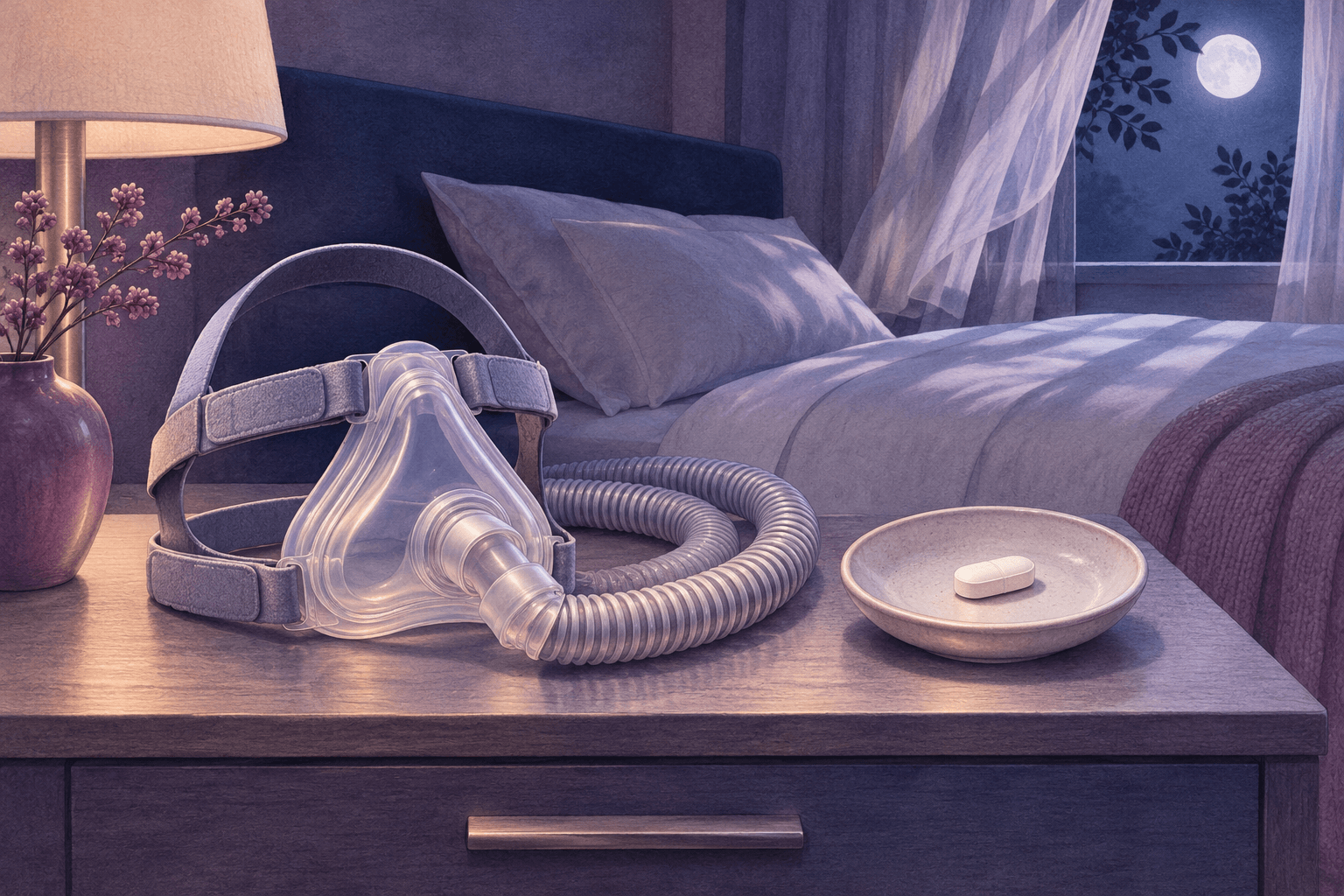
CPAP, the bedside machine that pushes air through a mask to keep the airway open during sleep, is the standard treatment for sleep apnea, and many people find it hard to stick with. Two trials published in JAMA asked whether a daily pill could change the picture.
The pill is orforglipron, sold as Foundayo, a GLP-1 drug. The ATTAIN-OSA program randomly assigned 712 adults with moderate-to-severe sleep apnea and a BMI of at least 27 to the drug or a placebo for 52 weeks. One trial enrolled 363 people not using CPAP; the other enrolled 349 who were.
Breathing interruptions fell by about 18 an hour on orforglipron and about 5 an hour on placebo, with broadly similar results in both trials. People on the drug lost about 10–11% of their body weight, against 1–2% on placebo, and that weight loss probably does much of the work.
Eli Lilly, which makes the drug, funded both trials, and follow-up lasted one year. People with diabetes or mild sleep apnea were excluded. In the non-CPAP trial, 12.2% stopped the drug because of side effects, mainly nausea, diarrhea and constipation, compared with 3.8% on placebo. Foundayo is approved in the US for weight management, not sleep apnea, and the researchers say it should not replace CPAP.

BMI alone missed who was at risk among 844,000 adults
- Observational study
- 844,108 adults in four countries
BMI, your weight measured against your height, is the number most people get at a checkup. In 2025 a Lancet Diabetes & Endocrinology Commission proposed a different way to define obesity. A Nature study published 11 November put it to the test using health data from 844,108 adults in China, the UK, the US and Spain.
The framework first checks that excess fat is really there, pairing BMI with a waist measurement or waist-to-height ratio. Then it splits obesity in two. 'Clinical' obesity means excess fat is already harming organs or getting in the way of daily life. 'Preclinical' obesity means the excess fat is present without that harm so far.
Measured against the framework, BMI on its own erred in both directions. Depending on the cohort, it missed obesity in 5.2–8.6% of people and labeled it wrongly in 1.2–3.1%.
The two categories also tracked with very different outcomes. Clinical obesity was linked to about 69% higher mortality. Preclinical obesity carried a much smaller increase, about 19%. Obesity defined by BMI alone showed no excess mortality at all. Clinical obesity made up only about 23–31% of obesity cases, and over 10 years, 77–91% of people with preclinical obesity did not progress to it.
These are associations in observational data, so they do not show that fat caused the deaths. Information on organ problems came from health records rather than new examinations. The four cohorts differ in age, ethnicity and health systems, and the US cohort, All of Us, is made up of volunteers. The biggest open question is practical: no one has yet tested whether using this framework in clinics leads to better care or better outcomes. That would take trials.
Five more worth your time
GLP-1 drug labels now warn about a rare cause of sudden vision loss
- Multiple studies
The FDA now requires every GLP-1 medicine to warn of a potential risk of NAION, a rare optic nerve stroke whose trial estimate rests on just 15 events, and advises getting care right away for sudden, painless vision loss in one eye, then discussing with a clinician whether to continue the drug.
U.S. Food and Drug AdministrationA new kind of blood thinner is approved to prevent a second stroke
- Regulatory approval
- 12,327 patients in the supporting trial
The FDA approved asundexian, the first pill to block the clotting protein factor XIa, for use with antiplatelet medicine after a recent stroke not caused by a clot from the heart or a high-risk mini-stroke, after a trial showed about a 26% relative reduction in repeat strokes, though gastrointestinal bleeding was higher and it is not approved for atrial fibrillation.
AJMCWhy older bodies may be slower to warm up, at least in mice
- Animal or lab study
In aged mice, an inflammatory signal called IL-1β holds more heat-making brown fat cells in a low-output setting so they respond to cold more slowly; human tissue showed a similar mix of cells, but the work is almost entirely in mice and the drug used to reverse it, mifepristone, is not a treatment for feeling cold.
NatureThe jolt as you drift off tracks with anxiety and poorer sleep
- Observational study
- 194 adults
In an exploratory online survey of 194 adults, people with weekly sleep starts, the sudden jerks some feel while falling asleep, reported poorer sleep and more anxiety, though a single self-reported snapshot cannot show which comes first.
PLOS Mental HealthOlder brains show weaker fluid waves during sleep
- Observational study
- 72 adults
MRI scans found smaller overnight waves of cerebrospinal fluid in healthy adults over 60 than in younger adults, partly tied to less responsive blood vessels, though the study measured fluid flow rather than waste clearance and did not test any link to dementia.
Nature Aging
The UC Irvine team still has its fall clock-change data to work through, so the other half of that story is yet to come. Until next week.
Get the next issue by email
Our weekly newsletter on what is new in health research, explained for curious readers and linked to the original studies. One email a week.
Sources
Source titles are preserved as published.
- The aging human brain exhibits reduced hemodynamic and cerebrospinal fluid flow waves during sleep · Nature Aging
- Validation of clinical and preclinical obesity across global cohorts · Nature
- Clinical Obesity Tied to 69% Higher Death Risk in Study That Found BMI Alone Did Not Predict Mortality · Medical Daily
- Bistable regulation of adipocyte heterogeneity governs thermogenesis · Nature
- Getting Too Little Sleep Makes You Easier to Scam · Time
- PNAS study of phishing clicks around the spring clock change (linked from Time; publisher page returned an access error) · Proceedings of the National Academy of Sciences
- Stopping statins after 70 may be safer than expected, but there's a catch · ScienceDaily (American Heart Association release)
- Elderly Patients on Statins for Primary Prevention Can Stop, but It's Not Risk Free: STREAM · TCTMD
- Sleep starts: Phenomenology and associations with sleep, psychological, and demographic characteristics · PLOS Mental Health
- Daily oral GLP-1 medication reduced episodes of sleep apnea in adults with excess weight · American Heart Association Newsroom
- Lilly's Foundayo Pill Cut Sleep Apnea Breathing Events Nearly 44% in Adults Not Using CPAP in JAMA Trial · Medical Daily
- FDA Approves Asundexian, First FXIa Inhibitor to Prevent Repeat Stroke · AJMC
- FDA requires safety labeling changes for GLP-1 receptor agonists due to potential risk of NAION · U.S. Food and Drug Administration
- Neighborhood Exposome at Birth and Trajectories of Epigenetic Age Acceleration Across Childhood · JAMA Network Open
- Neighborhood Context and Childhood Epigenetic Aging—Risks, Resources, and Development · JAMA Network Open
Reference Range Weekly is for general information. It does not provide medical advice, diagnosis, or treatment.