A tape measure, a stopwatch, and a face photo
Several stories this week turn on measurements that take seconds: a tape around the calf, a short timed walk, a single photograph. In each one, the harder part is working out what the number really tells you, and what it can't.

- Observational study
- 15,124 full-term infants
Expectant parents now have two ways to shield a newborn from RSV. The mother can get a vaccine during pregnancy, called RSVpreF, or the baby can get nirsevimab, a long-acting antibody given after birth. Which works better?
Researchers at Kaiser Permanente Northern California looked at full-term babies born across the 2023–24 and 2024–25 RSV seasons. Their main comparison matched 11,293 infants whose mothers were vaccinated with 3,831 who received the antibody.
Compared with babies who had neither, maternal vaccination was associated with 69.3% effectiveness against infection and 86.4% against hospitalization. For nirsevimab, the figures were 65.2% and 73.8%.
Head to head, the study found no statistically significant difference. That doesn't prove the two are identical. Just 12 babies were hospitalized in the main comparison, too few to rule out smaller differences.
This was a look back at health records, not a trial. Families who chose each option may differ in ways the data didn't capture, and testing was at clinicians' discretion. The results cover full-term infants in one insured California system. Some authors reported outside grants from vaccine makers, including Pfizer, Moderna, Sanofi, and GSK.
Published October 25, 2026
- Animal or lab study
BCG, a tuberculosis vaccine, is also used to treat bladder cancer. Observational studies of those patients turned up something odd: the treatment was linked to less dementia. Nobody could say whether the vaccine deserved the credit, or how it might work.
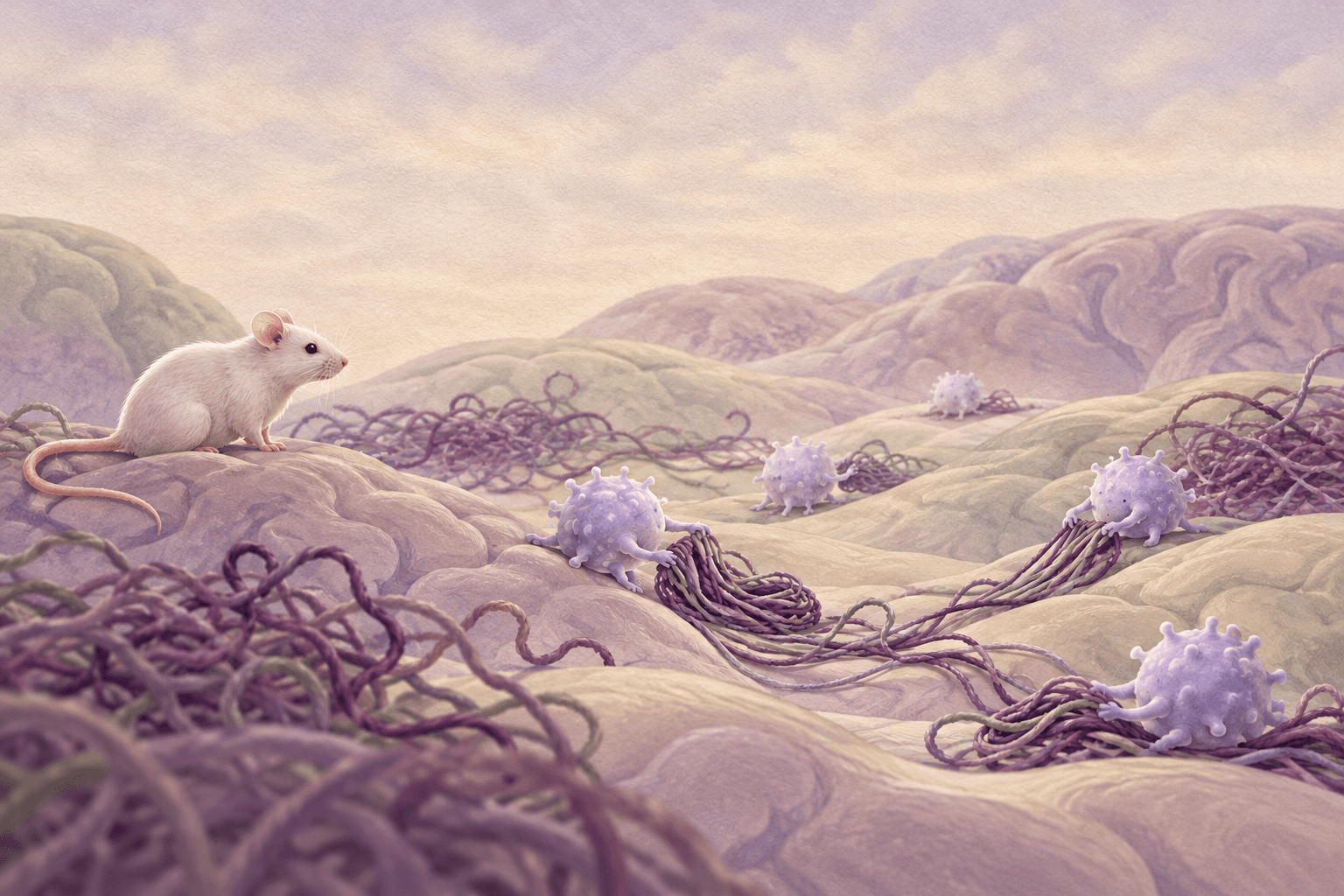
A study in Science Advances tested the question in PS19 mice, which are bred to develop tangles of tau, a protein that builds up abnormally in the brain. The mice received BCG or saline at 3 months old and were examined months later.
The vaccinated mice had less chemically altered tau in the hippocampus, a brain region central to memory. Their brains shrank less, they did better on a test of recognizing new objects, and they survived longer.
BCG reprogrammed immune cells, which then took up more tau fibrils. That could help explain the findings, but the mechanism remains unconfirmed. PS19 mice capture tau damage, not the whole of Alzheimer's disease. The human hint still comes from looking back at bladder cancer patients rather than from a trial. Whether BCG safely protects people from dementia remains unknown.

- Observational study
- 34,363 photos of patients with cancer
Doctors have long sized up how well a patient looks. Researchers at Mass General Brigham built a model to put a number on that impression. FAHR-Face learned from more than 40 million facial photographs. It was then fine-tuned for two jobs: estimating biological age and predicting survival.
The survival version was tuned on 34,363 photos of people with cancer. Among cancer patients, those it placed in the highest-risk quarter had more than three times the mortality of those in the lowest. The two models picked up different information, and using both together improved predictions.
So far, it has been tested mainly in cancer patients, so its performance in the general population is unknown. The authors present it as support for a doctor's judgment and plan broader testing.
A health estimate drawn from a selfie raises another question: who else might run your photo through a model like this, and what they would do with the answer.
- Observational study
- 7,068 adults aged 60 or older
- median 3.07 years
A tape measure around the calf takes seconds. Researchers in China asked whether that measurement, taken twice a few years apart, could pick out who is more likely to fall.
They followed 7,068 community-dwelling adults aged 60 or older from 2018 to 2021, a median of 3.07 years. Their average age was 79.7. By the end, 23.6% reported a fall in the past year.
Those whose calves shrank by 5 cm or more had 33% higher odds of falling than those with no shrinkage. The pattern held after researchers set aside people who had already fallen at the start.
A tape can't tell muscle from fat or fluid. Only the right leg was measured, and falls were self-reported. Because shrinkage and falls happened over the same stretch, a fall, or the illness behind it, could have caused the shrinking. The follow-up overlapped the pandemic, and everyone lived in China. This study cannot show that rebuilding calves prevents falls.

- Observational study
- 4,067 Whitehall II participants
- median 11.8 years
On one side, a nurse with a stopwatch timing someone's walk over a 2.44-meter course. On the other, a wrist accelerometer worn for nine days, recording cadence, or steps per minute, through ordinary life. Which tells you more about survival?
Researchers tested both in 4,067 Whitehall II participants, average age 69.3. They followed them from 2012–2013 for a median of 11.8 years; 739 died.
Faster clinic walking speed, typical everyday cadence and peak cadence all went with lower mortality after accounting for other factors. All three ranked people about equally well. But only the clinic walk significantly improved prediction beyond standard risk factors. It nudged the C index, a score of how well a model sorts people by risk, from 0.742 to 0.747.
That is a small gain. The two kinds of walking also lined up weakly, with correlations around 0.27–0.28. A deliberate walk under observation and everyday walking seem to capture different parts of mobility. An accompanying commentary suggested using clinic speed as a first-line measure, with wrist data as a second layer.
The study is observational, so it can't show that walking faster changes anyone's odds. Participants were mostly White (92.5%) and male (74.4%). The accelerometer group was healthier than the wider cohort, and there was no outside dataset for validation. There is no agreed method for measuring cadence from a wrist. Could a better tracker measure close the gap?
Five more worth your time
A pancreatic cancer vaccine missed its goal but left signals to test
- Randomized trial
- 144 patients after pancreatic cancer surgery
In a maker-sponsored randomized trial of 144 patients after surgery, a KRAS-targeting vaccine didn't significantly extend disease-free survival, though unadjusted subgroup results and immune responses in 89 of 90 tested patients led the authors to call for phase 3 testing.
Nature MedicineCould a short gap between pregnancies speed up maternal aging?
A review with no new data proposes that starting another pregnancy before postpartum recovery finishes might shape long-term maternal aging, and sets out predictions that only decades of follow-up could test.
Trends in Endocrinology & MetabolismUltra-processed diets and children's brain responses to food pictures
- Observational study
- 46 children aged 7 to 10
- 1 year
In 46 children, more ultra-processed food went with a stronger response to food images in one brain region that predicted fat gain a year later, but adjusting for added sugar erased the diet link and commentators want replication.
JAMA Network OpenMany frail older breast cancer survivors get no Medicare home health care
- Observational study
- 134,410 older breast cancer survivors
Billing data on 134,410 survivors found no Medicare home health use in 59.6% of high-frailty years, though frailty was estimated from claims and the study measured use rather than need.
Journal of the National Cancer InstituteCould retuning cell signals help treat diseases of aging?
A perspective proposes rebalancing networks of cell receptors to address age-related disease, but reports no new experiments and no proven benefits for healthy lifespan.
Frontiers in Science
Every story links to its sources, so you can check the numbers yourself. Back next Sunday with another week of research.
Get the next issue by email
Our weekly newsletter on what is new in health research, explained for curious readers and linked to the original studies. One email a week.
Sources
Source titles are preserved as published.
- Longitudinal Change in Calf Circumference and Incident Falls in Older Adults · JAMA Network Open
- Clinical Walking Speed, Free-Living Walking Cadence, and All-Cause Mortality · JAMA Network Open
- Measuring Mobility Function in Everyday Life—Beyond the Stopwatch · JAMA Network Open
- Ultraprocessed Food Intake, Striatal Response to Food Cues, and Adiposity Gain in Children · JAMA Network Open
- BCG vaccination mitigates tau pathology and restores cognitive function in PS19 mice · Science Advances
- Tuberculosis vaccine's link to reduced dementia risk gains mechanistic support · Medical Xpress
- Maternal Vaccination vs Nirsevimab Use and Respiratory Syncytial Virus Infection Among Full-Term Infants · JAMA Network Open
- Claims-based frailty, dual eligibility, and potential unmet home-health needs in older breast cancer survivors · Journal of the National Cancer Institute
- The postpartum recovery window as a determinant of maternal aging · Trends in Endocrinology & Metabolism
- Foundation artificial intelligence models for health recognition by use of face photographs (FAHR-Face): a model development and validation study · The Lancet Digital Health
- AI facial health recognition tools help physicians assess age and survival risk to guide personalized treatment · Medical Xpress
- Network-level control of G protein-coupled receptors: a panacea for chronic diseases? · Frontiers in Science
- Lymph node-targeted, mKRAS-specific amphiphile vaccine in pancreatic cancer: the randomized phase 2 AMPLIFY-7P trial · Nature Medicine
Reference Range Weekly is for general information. It does not provide medical advice, diagnosis, or treatment.